
I help people pick tables that fit their rooms, plans, and daily routines. My advice comes from solving real layout problems and matching materials to how families live. In this guide, I share how I think through size, shape, seating, materials, and finish, and why a custom or hand-finished option often brings the best long-term value.
If you want a quick way to see real options while you read, browse Legacy Hardwood’s dining tables for examples of sizes, shapes, and finishes that work in both compact and large rooms.
Start With Space and Flow
Measure your room from wall to wall, then map the area you plan to use for the table.
- Leave about 36 inches from the table edge to a wall or cabinet for pull-out room and easy movement.
- In narrow rooms, you can work with 30 inches, but only if doors and drawers still open.
- Add the space chairs need when pushed back. Plan for 18 to 24 inches behind each chair.
I suggest taping the footprint on the floor. Walk around it. Pull in a couple of chairs to test movement. This simple check saves you from crowding and returns.
Pick a Shape That Matches How You Gather
- Rectangle: Best for long rooms and larger groups. Easy to seat six or more.
- Round: Great for square rooms and better eye contact. A pedestal base helps legroom.
- Oval: Softer corners for tighter walkways while still seating many.
- Square: Works in small, square rooms. Keep size modest or it dominates the space.
If you host mixed group sizes, consider an extension top. Leaves give you weekday compact use and weekend capacity without a second table.
Seat Count and Base Style
Think in terms of people and comfort, not only inches.
- Four seats: about 48 inches long for a rectangle, or 42 to 48 inches round.
- Six seats: about 72 inches long, or 54 to 60 inches round.
- Eight seats: about 84 to 96 inches long, or 60 to 72 inches round.
Base style shapes how people sit:
- Four legs: Classic look, but watch corner leg interference.
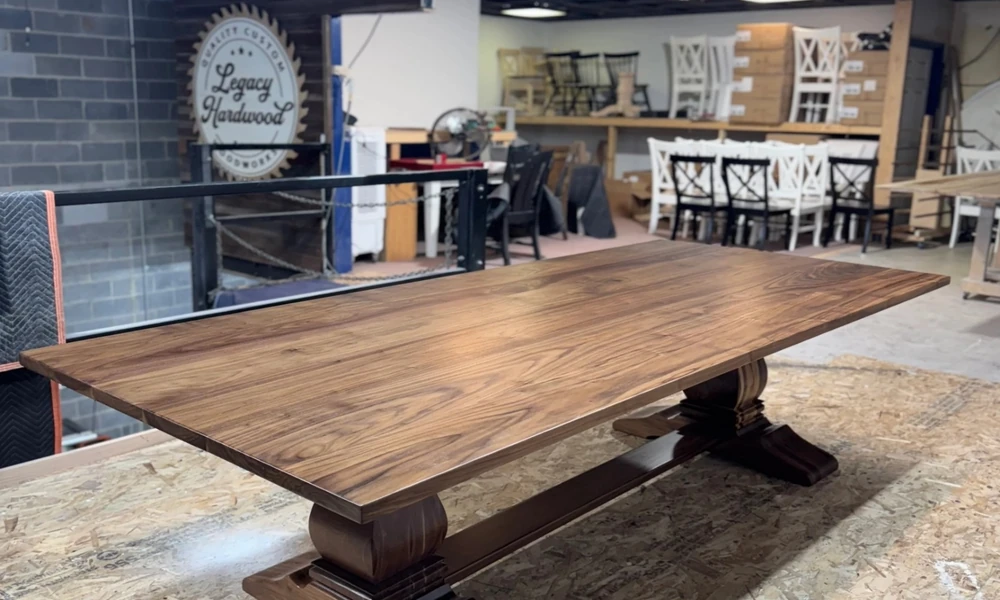
- Trestle: Strong support on long tables with good center clearance.
- Pedestal: Great for round tables and flexible chair spacing.
If you plan benches, a trestle or pedestal base often works best.
Height and Everyday Comfort
Standard dining height is about 30 inches with seat height close to 18 inches. That gives most adults enough legroom. If you use armchairs, check the arm height against the tabletop and apron height. Low aprons help slide chairs in without scraping.
Materials That Last
Solid hardwood holds up, can be repaired, and gains character with use. If you want a lighter look, a hardwood veneer over stable core can work, but it needs a quality edge and finish.
With natural wood, movement is normal as seasons change. Small gaps between boards can open or close. If you prefer to avoid gaps, ask for a jointed-top option that moves as one unit.
Stone and metal tops resist heat and marks, but they feel cool and hard. Think about how you like to set a table, the sounds of plates and glasses, and the feel under your hands.
Finish, Stain, and Texture
Finish protects the surface and sets the tone of the room.
- Stain color: Match to floors or contrast them. Mid tones hide crumbs and fingerprints better than very dark or very light tones.
- Sheen: Satin hides marks better than high gloss and feels soft to the touch.
- Distressing: A clean sanded top reads refined. A more distressed top hides daily marks and suits a farmhouse story.
- Special textures: Band-sawn oak gives visible saw marks and a tactile feel. Smooth oak gives a flatter surface for writing or homework.
I suggest bringing a paint chip or floor sample to compare. Ask to see a large finish sample, not only a tiny chip.
Construction Details to Check
- Joinery: Solid corner blocks and secure joints keep the table quiet and stable over time.
- Stretchers and supports: Long tables need center support to prevent sag.
- Leaves and hardware: Leaves should sit flush and lock tight.
- Levelers: Small glides under legs help on uneven floors.
- Edges: Softened edges are kinder to forearms and safer for kids.
Run your hand along the underside. You want smooth edges and no sharp screw tips.
Budget, Lead Time, and Delivery Plan
Set a range for the table alone and a total that includes chairs and delivery. Custom pieces take time. Four to ten weeks is common for hand-built work. Plan your delivery path from door to dining area. Measure stairwells, tight turns, and landings. Protect floors on delivery day.
Why I Recommend Legacy Hardwood
Legacy Hardwood is a custom furniture studio in Chantilly, Virginia. They build solid wood tables with a small team of local craftspeople and help you tailor dimensions, seat count, and base style to your room. They offer standard hardwoods and can source others by request. You can select stain, paint, level of distressing, and even band-sawn oak if you want more texture. If you like a smoother top for writing or homework, ask for smooth oak.
They also offer a jointed-top option for those who prefer fewer board gaps, and a satin lacquer finish for protection. Their team guides you on size and proportion, which helps if your room has odd alcoves or an off-center light. The showroom and shop let you see work in progress, touch finishes, and sit at completed chairs, which builds confidence in your choices. They provide a warranty for manufacturing defects tied to structure, and they focus on build quality over rushing lead times. If you have a specific idea, they review custom inquiries and document the details in the order.
If you want a table that fits your room now and still works after a move or remodel, their mix of customization and practical guidance is a strong match.
A Quick Pre‑Order Checklist
- What is the room size, and how much clear floor do you have after chairs push back?
- How many people do you seat most days, and how many on special occasions?
- Which shape suits the room and traffic flow?
- Which base style gives the best legroom for your chairs or bench plan?
- What table length and width match your chair widths and arm heights?
- Which wood species and finish fit your floors, cabinets, and light levels?
- Do you prefer a clean top or visible distressing and texture?
- Do you want an extension table, and how wide should each leaf be?
- What lead time fits your schedule?
- How will the table get through doors, stairs, and hallways?
Care Basics That Keep Your Table Strong
Use placemats or trivets for hot dishes. Wipe spills fast with a soft cloth. Avoid harsh cleaners. Keep indoor humidity steady through the year. Lift to move the table rather than dragging it. Rotate where people sit to even out wear.
With these steps, a solid wood table keeps its shape and character for years.
Pick size and shape based on your room and your routine. Choose materials and finish that match how you live. If you want hands-on help and true customization, Legacy Hardwood offers clear options and guidance that make the choice easier and the result last.